Chronicle 002 of 365
The clock was wrong
The story of Seu Osvaldo, who was never late.
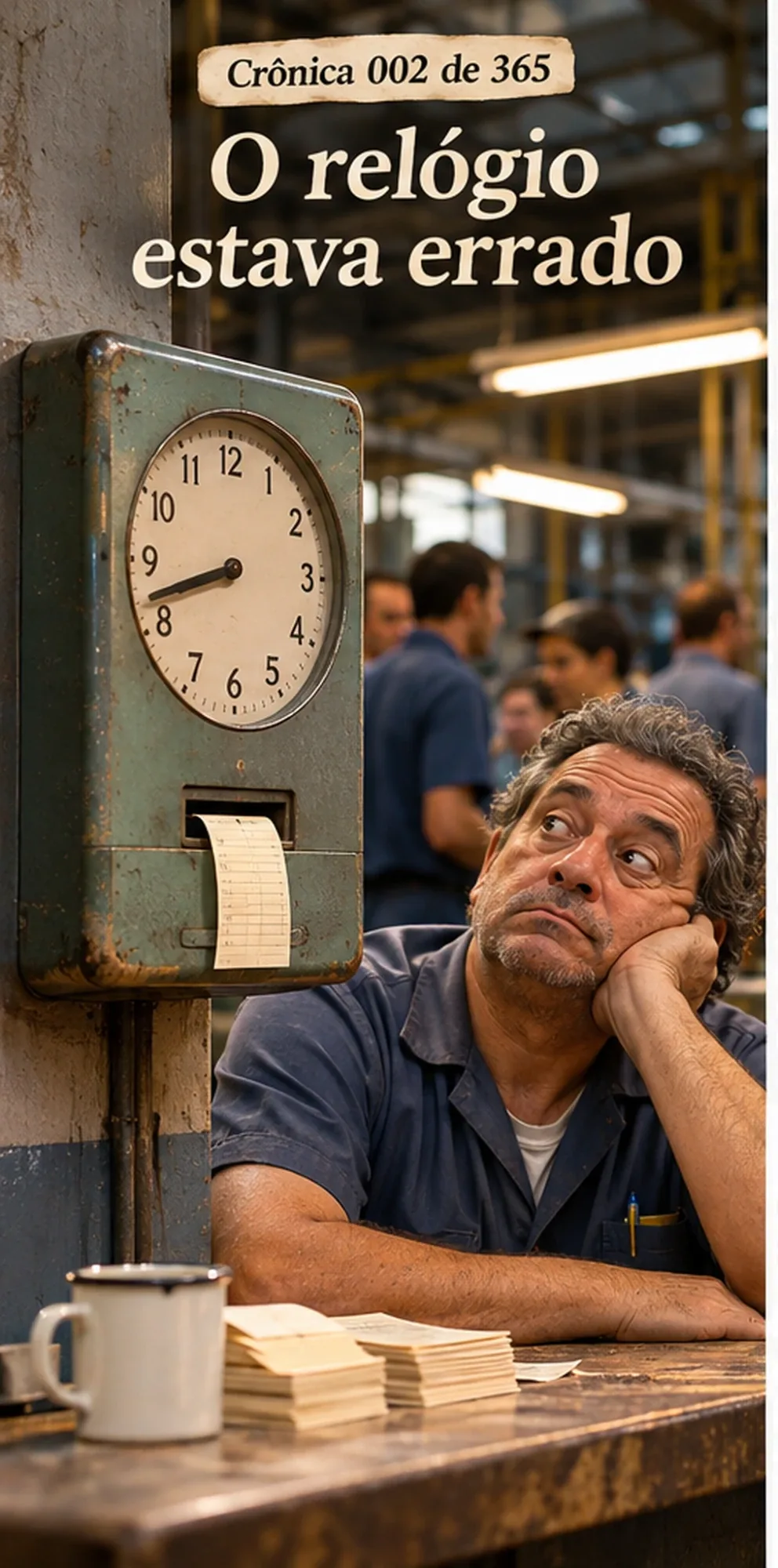
Seu Osvaldo did not tolerate lateness. Least of all his own.
Seu Osvaldo arrived at the office at seven minutes past eight. That was a fact. Another fact: he had never once agreed with the phrase “seven minutes late.”
The reception clock ran fast. It always had. And if anyone had the nerve to dispute the word of a wall clock, that was the company’s problem, not Seu Osvaldo’s.
“I got here at eight,” he would announce, setting his briefcase on the desk with the firmness of a man who had just won a lawsuit.
“The time clock says eight-oh-seven.”
“The time clock has problems.”
Over the past three years, every object that disagreed with Seu Osvaldo had turned out to have problems. The air-conditioning thermostat. The pharmacy scale. The app that showed rain whenever he left without an umbrella. Once, the alarm clock was promoted to personal enemy.
The manager, a man of gentle manners and few convictions of his own, decided to settle the matter with modernity.
“We’re installing a new system.”
The system arrived on a Monday, accompanied by two technicians, three cables and a manual nobody was reckless enough to read. On Tuesday, the report said Seu Osvaldo had arrived at eight-oh-seven.
“The new system has problems,” he said.
On Wednesday, the manager called a meeting.
“We need to understand what’s going on.”
“At last,” Seu Osvaldo replied. “Someone is going to investigate that clock.”
Out came spreadsheets, charts, a twenty-six-page presentation and a trend line. The analyst explained that, over forty working days, Seu Osvaldo had clocked in after eight on thirty-eight of them.
Seu Osvaldo was impressed.
“Forty days? That many? Feels like the month started yesterday.”
The analyst went on. There was a curious clustering of times. Five past eight, six past, seven past. Very little variation. Seu Osvaldo looked at the chart and immediately recognized the culprit.
“See? It’s a pattern. Faulty clocks do that kind of thing.”
The intern, who until then had been busy drawing little squares in her notebook, asked if she could pose a question.
“What if we compare it with the time on the lobby camera?”
The manager hesitated, because that was not in the presentation. The analyst smiled. Seu Osvaldo wanted to know whether the camera was certified.
On Friday, the team watched forty brief appearances of Seu Osvaldo walking through the door. In thirty-eight of them, he showed up after eight. In the footage from one particularly memorable Monday, he stopped in the lobby to chat with the security guard about a football coach who had just been fired.
“That conversation was important,” he explained.
“That’s not what we’re discussing,” the intern replied.
A silence followed. A sturdy silence, the kind found in a room without air conditioning.
The following Monday, Seu Osvaldo walked in at seven fifty-nine. He greeted the security guard, clocked in and went to his desk. The manager, proud of the digital transformation, asked what had changed.
“Nothing,” said Seu Osvaldo. “I just came in earlier so I wouldn’t have to argue with the camera.”
At the end of the day, the reception clock was taken down for maintenance. It was working perfectly.
Seu Osvaldo heard the news and thought it best not to comment. Some evidence, once it piles up, becomes inconvenient.